PVC Ceiling Price: How a Quotation Is Worked Out
A PVC ceiling price covers more than the panels. This guide shows how a quotation is built from area, panels and trims, site condition and extra work, and why per-piece prices online rarely compare like for like.
Introduction
Why does one seller quote per piece and another per square foot?
If you have searched for a PVC ceiling price, you have probably seen numbers that don't line up. One seller quotes per piece, another per square foot, and a contractor gives a single lump sum.
Each of them is pricing something different. This guide explains how a PVC ceiling quotation is put together, what our starting price covers, and how to compare quotes fairly.
What Our Starting Price Covers
Panel supply starts from RM29 per sq ft. That figure is for the PVC panels only. Installation, trims and site work are quoted separately, line by line, in the itemised quotation.
We keep them apart on purpose. Two porches of the same size can need very different amounts of trim and site work, so one all-in rate would be too high for one job and too low for the other. The PVC ceiling price section on our homepage shows the quotation layout.
The Four Things That Set a PVC Ceiling Price
1. Dimensions and area
Every quotation starts with length × width for each ceiling, worked out in square feet. A car porch of 20 ft × 12 ft is 240 sq ft. A bathroom of 8 ft × 6 ft is 48 sq ft. If a ceiling has steps, beams or an L shape, each part is measured on its own.
A rough measurement is enough for a first quotation. Photos help even more, because they show the shape of the ceiling and anything in the way.
2. The panels and trims you choose
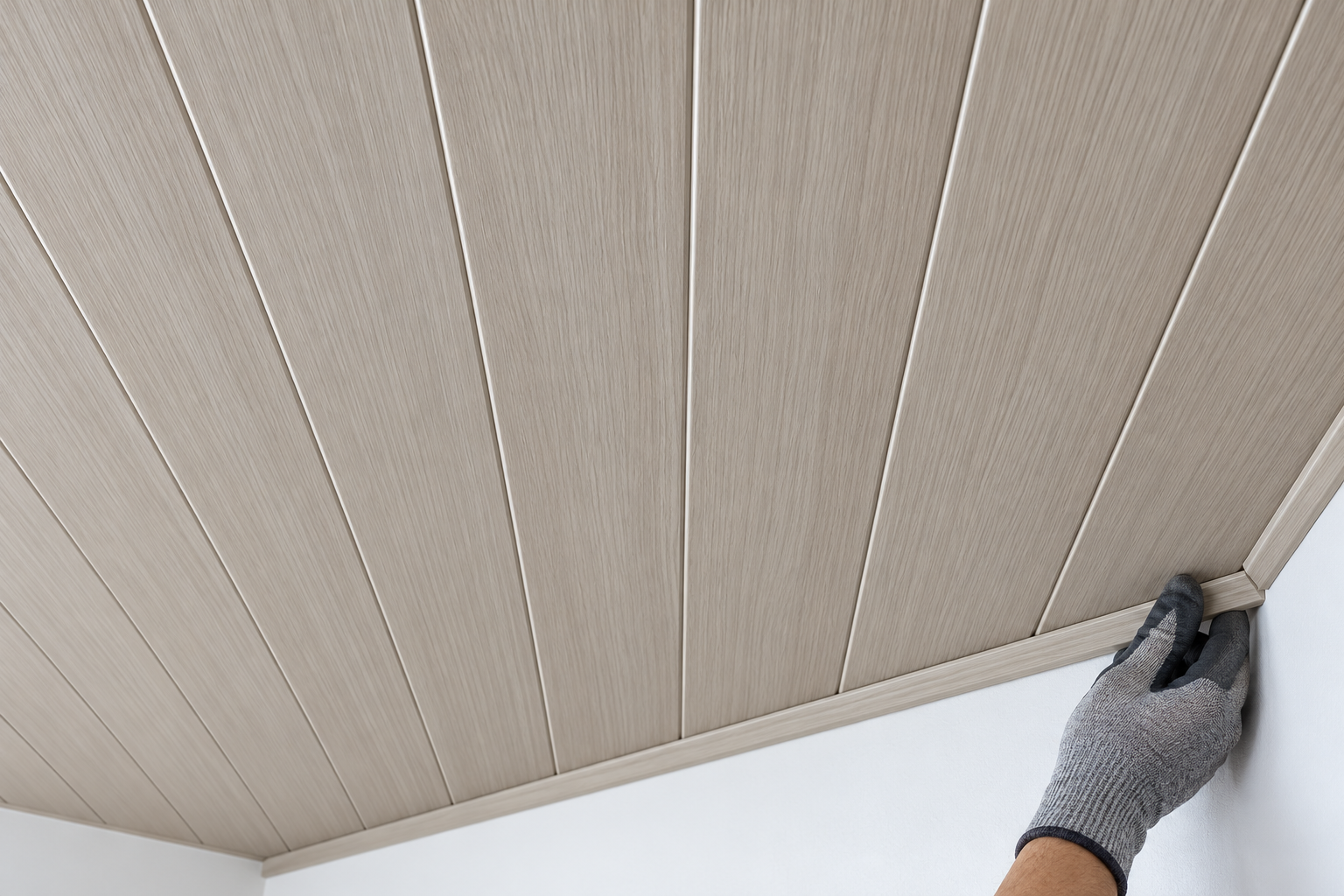
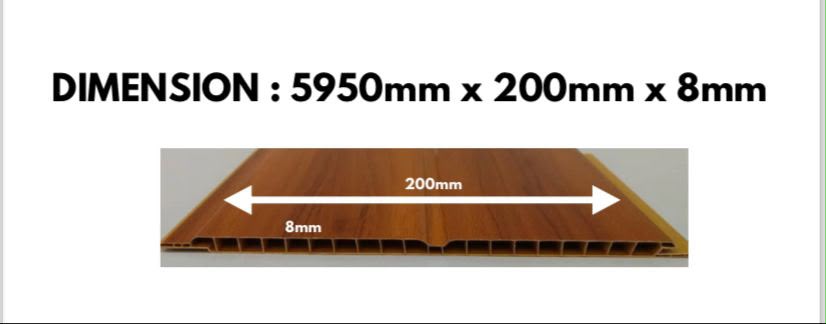
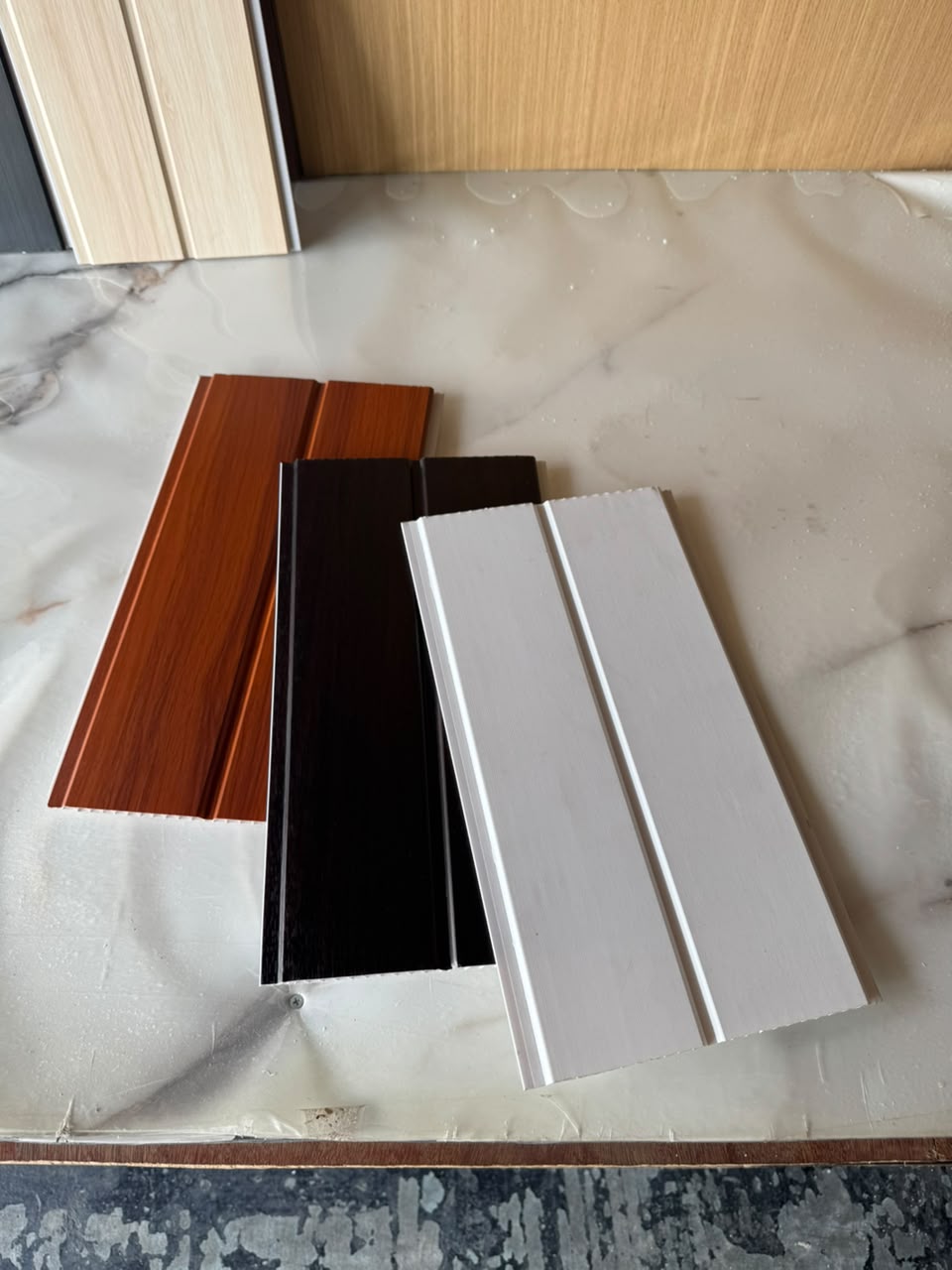
Our panels are 5950 × 200 × 8 mm hollow-core strips in six finishes: four woodgrain (103 Walnut, 105 Alder, 107 Sandal Wood, 114 Grey Teak) and two plain (108 White, 111 Black). You can compare them in the PVC ceiling designs collection.
Trims are the part people forget. L trims finish the edges and corners, U trims cap the cut ends, and H trims join two lengths where a run is longer than one panel. A long, narrow walkway can need more trim per square foot than a square bedroom.
3. Site condition
Ceiling height, how easy the ceiling is to reach and what is already up there all count. A double-volume ceiling, or a porch above a sloping driveway, needs more set-up than a standard room.
An existing frame that is level and sound can sometimes be reused. One that is uneven, rotten or damaged by termites has to be put right first.
4. Additional work
Anything beyond fitting new panels goes on its own line. Typical items are removing an old ceiling, new framing, and cut-outs for downlights or a ceiling fan.
If your old ceiling is stained from a leak, read our guide to leaking and sagging ceilings first. The leak has to be fixed before any new ceiling goes up.
Per Piece or Per Square Foot: Why Online Prices Don't Compare
What a per-piece price leaves out
A price per piece tells you about one panel and nothing else. It does not say how long the panel is, how thick it is, whether it has a hollow core, or whether trims, frame, delivery and installation are included.
Panel lengths also vary between products. A short panel at a low piece price can work out dearer per square foot than a long panel at a higher piece price.
Converting pieces to square feet
One of our panels, 5.95 m × 0.2 m, covers about 12.8 sq ft on paper. In practice you never use every inch: panels are cut to fit at the walls and around lights, so a sensible quotation allows for offcuts.
That is why we quote panels by area and list everything else separately. You can see what you are paying for, and you can hold two quotations side by side.
How to compare two quotations fairly
- Same area? Check that both quotes measured the same ceilings.
- Same panel? Length, thickness and finish should match.
- Trims listed? L, U and H trims should be on the quote, not assumed.
- Installation and site work? Make sure both quotes include them, or both leave them out.
- Extra work? Removal of an old ceiling and light cut-outs should be listed if you need them.
What an Itemised PVC Ceiling Quotation Looks Like
Our quotations follow the same layout every time, so nothing is bundled out of sight:
- PVC ceiling panels in your selected finish, by area
- L, U and H trims
- Installation
- Site work, such as frame, access and height
- Additional work, if any, such as removing an old ceiling or cutting light openings
Each line has its own quantity and amount. If you change the finish or drop an item, you can see exactly which line moves.
FAQ
How much does a PVC ceiling cost per square foot?
Panel supply starts from RM29 per sq ft. Installation, trims and site work depend on your space and are listed separately, so the all-in cost per square foot varies from job to job.
Why is my quotation higher than the per-piece price I saw online?
The online price usually covers one panel only. A quotation for a finished ceiling adds trims, installation and any site work, none of which a piece price shows.
Do I need exact measurements before asking for a price?
No. A rough length and width plus a few photos is enough for a first quotation. If anything is unclear from the photos, we will ask.
Is removing my old ceiling included?
Removal is additional work, so it appears on its own line when your job needs it. If it doesn't, the line isn't there.
Get Your Itemised Quotation
Send your location, a rough ceiling size and a few photos of the space on WhatsApp. We will suggest a finish and send a line-by-line quotation.
We supply and install across Malaysia, including Ipoh, Kuantan and PVC ceiling in Kota Kinabalu.
Conclusion
A PVC ceiling price comes from four things: the area, the panels and trims you pick, the site condition and any extra work. Per-piece prices online leave most of that out.
Ask for a quotation that lists each part, and compare quotations line by line rather than by the total. If you are still deciding on materials, our guide to PVC ceiling panel sizes and trims explains what each part of the system does.